

The REI CRM Handbook for High-Volume Wholesaling Teams

Pete REI CRM
www.peterei.com | [email protected]
October 2025 | Real Estate CRM Scaling Checklist
How to Use This Handbook
This handbook is meant to be used alongside your day-to-day REI CRM activity.
• Read sections based on your role.
• Implement one framework at a time and start with the seller lifecycle
• Use it as a reference during onboarding and weekly reviews
• Compare each section with how your current CRM actually works
If your CRM can’t support what is outlined here, the gaps will become obvious. In that case, you should rely on the best CRM for investors.
Who This Handbook Is For
High-volume wholesaling teams operate in a very different reality than solo investors or traditional sales organizations.
This handbook is written for teams that:
• Generate hundreds or thousands of seller leads per month
• Work with distressed, uncertain, or emotionally complex sellers
• Manage multiple acquisition managers or lead handlers
• Depend on long-term follow-up to hit monthly deal targets
These teams face problems when sellers are contacted by multiple team members over time. Teams might find this handbook useful when context is lost due to ownership changes. If your deals close months after the first conversation, you should use this handbook.
This handbook is not designed for:
• Solo investors doing occasional deals
• Short-cycle retail sales environments
• Agent pipelines where deals close quickly or not at all
Primary objective:
After reading this wholesaling handbook, your goals should be to create a repeatable system where seller motivation and movement are visible across the team. So, no one relies on individual memory.
The Reality of High-Volume Wholesaling
Volume creates noise in wholesaling. Investors can rely on their memory when the deal volume is low. They can remember which seller sounded motivated and why a deal didn’t work.
However, memory fails with high volume.

Yet most teams structure their CRM around the first call. Deals are lost in this mismatch.

The outcome of a lead is determined by follow-up timing.
What deals are lost during the follow-up phase?
Deals that are linked to mis-timed opportunities are actually lost during follow-ups. When a seller has a situation that hasn’t fully matured, investors mark the lead as cold and the task expires. After that the note is buried somewhere but months later the property is sold to someone else.
Why this happens?
• You don’t have an REI CRM system to track why the seller wasn’t ready
• Lack of system means no visibility into long-term changes
• You don’t have ownership of cold or long-term leads
Teams often believe they’re following up because tasks exist in the system. But tasks alone don’t form a follow-up strategy. If you don’t have visibility into seller motivation or timing, your follow-up becomes reactive instead of intentional. A CRM should guide when, why, and how to re-engage.
See how a structured CRM turns follow-up into a repeatable deal system. Book a demo of Pete REI CRM.
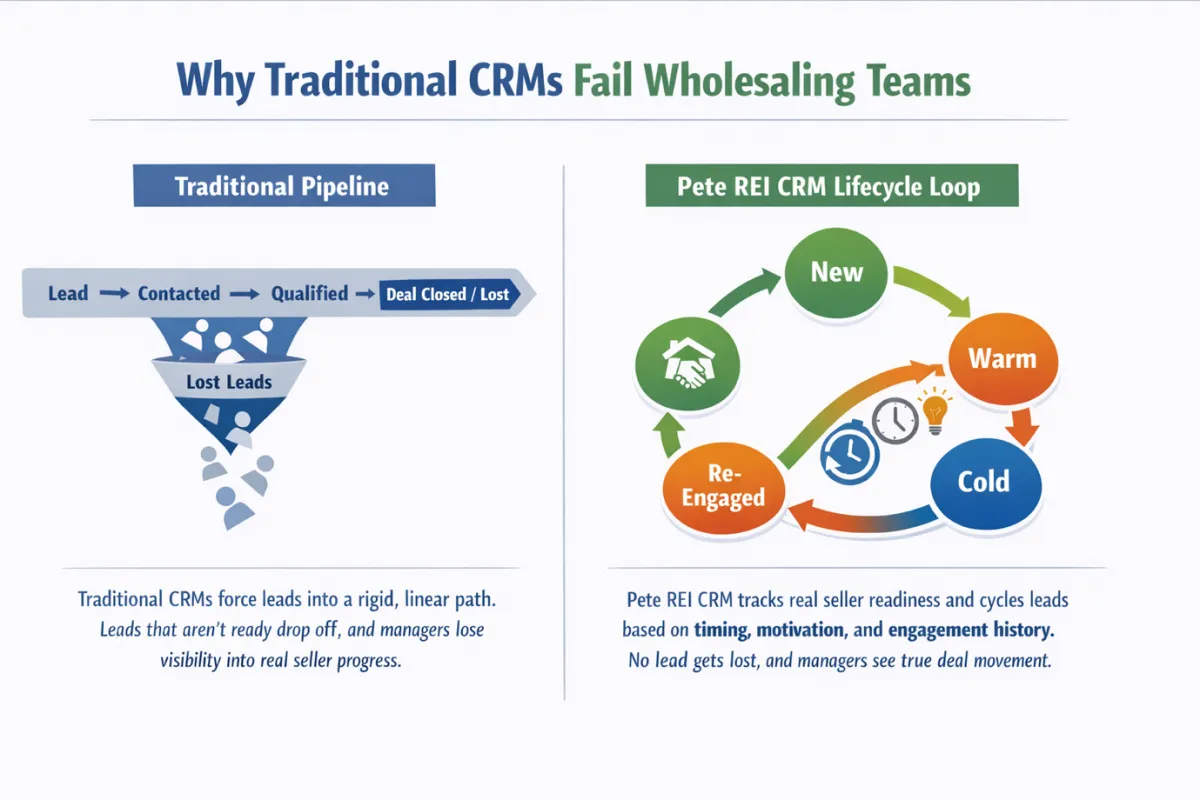
Why Traditional CRMs Fail Wholesaling Teams

Most CRMs are built for predictable, linear sales cycles. In those sales based CRMs, leads either move forward or drop off. These systems are made around sectors where decisions happen quickly.
Wholesaling violates all these assumptions. And this is why a common CRM fails. Rather, you need a purpose-built CRM software for real estate investors, which should have:
• Reflect real seller readiness instead of forcing leads into oversimplified pipeline stages
• Trigger follow-up based on motivation and timing.
• Structure seller history so insights don’t get buried in free-text notes
• Show deal progression, so managers can see what’s actually moving
The result is a system that looks busy but produces inconsistent outcomes.
Related Reading: If you want a full breakdown on why traditional CRMs break under wholesaling volume and how REI CRMs can save you, then read this guide. [The Future of Real Estate Investing: Pete REI CRM, Automation, and Scaling Strategies].
What should be the framework for the seller lifecycle?

How Sellers Typically Move

Sellers simply move into a different stage.
A CRM built for real estate investors can help you track these stages clearly. With a real estate CRM you ensure no opportunity is forgotten even when timing changes.
How to understand seller motivation through an REI CRM?
Wholesalers understand that seller motivation builds gradually. The key drivers can be finances, tenants, maintenance, or life events. A CRM won’t tell you exactly when they’ll sell, but it helps you notice the signs by tracking conversations and interactions. This way, you can act when the seller is ready.
“Are Seller Actions Telling the True Story?”
Sellers often say things they don’t fully mean. They might claim they’re just exploring options or ask you to follow up later. But real movement shows up in their actions.
Pay attention to the signals to prioritize leads who are genuinely moving toward a decision.

System principle for seller actions
Track what changed and not what was said.
How to have a strategic follow-up system?
Do you know what is more important than a frequent follow-up? Rather than being regular, it should be more relevant to be more effective.
Non-negotiable rules for a strategic follow-up:
• Every lead should have a next review date
• Cold leads must be reviewed, not ignored
• Follow-up logic should be shared across the team
Q: What is the difference between a blind follow-up and a strategic follow-up?
A: A blind follow-up is irregular and reactive. You reach out to the seller without context or purpose. A strategic follow-up is planned and relevant. Every lead has a next review date, cold leads are actively monitored, and the process is consistent across the team for better results.
How your team should use the CRM
High-volume wholesaling is a team sport. Without clear rules, new users can get lost or make mistakes. Your team can use the best CRM software for real estate investors with this strategy:
How to use the CRM as a team


This diagram shows how acquisition managers hand off leads. It is done after reviewing notes and defining next steps, so that the context stays updated.
What standards should your team follow to keep CRM data clear and consistent?
• Explain decisions in notes: Don’t just mark a lead cold, explain the reason.
• Justify status changes: Only change lead status if there is a clear reason.
• Preserve context when reassigning ownership: Include all notes and follow-ups so nothing is lost.
Following these steps prevents team errors and every lead gets the attention it needs.
What to Track (And What to Avoid) in an REI CRM
More data does not equal better insight.

Focus on tracking the information that actually helps you move deals forward in a CRM. Track seller’s motivation level, the reason a lead is in its current status, and how much time has passed since the last meaningful change.
Avoid cluttering the system with too many custom fields. Avoid long story-like notes, or metrics that look impressive but don’t affect results. Keep your CRM clean and focused to make better decisions and follow up more effectively.
Q: How do you make seller movement visible and improve follow-up?
A: Track and visualize seller activity for a better follow-up. You can spot warming opportunities, reallocate follow-up efficiently, and coach your team more effectively. When movement is visible follow-up goes from guesswork to a strategic, data-driven process.
How to implement this framework?
30-Day Rollout Plan
Week 1: Define lifecycle & terminology
Set clear stages for leads and agree on consistent terms so everyone speaks the same language.
Week 2: Clean and tag existing leads
Audit and organize the current pipeline. Accurately tag leads for precise tracking and analysis.
Week 3: Train team on usage rules
Show your team how to use the CRM, update statuses, and follow handoff and note-taking standards.
Week 4: Review movement weekly
Check lead activity each week to see progress and adjust follow-up strategies.
Where Pete REI CRM Fits
Generic CRMs are designed for linear sales but Pete REI CRM is different. It is built around real seller lifecycles. It works exactly the way deals actually unfold in high-volume wholesaling.
It gives your team the tools to:
• See long-term follow-up clearly — no lead gets lost over weeks or months.
• Maintain team context — every interaction and decision is visible to all.
• Track seller motivation over time — know when a lead is warming up or cooling off.
• Review movement history instantly — understand how every lead progressed and why.
Pete REI CRM turns follow-up into a strategic, data-driven process. The framework outlined in this handbook is embedded directly into Pete’s design.
Book a Pete REI CRM Demo
If your team struggles with lost context, you need the best CRM Software for Real Estate Investors. Get rid of the problems of inconsistent follow-up or invisible opportunity at just $219 per month. Pete REI CRM brings structure to your follow-ups even when the wholesaling volumes grow.
Book a demo to see lifecycle-based wholesaling in action.
End of Handbook